DC Circuits stands for direct current circuits. These circuits are closed circuits that are connected back to the source of their power to complete the current. The way to solve different aspects of DC Circuits is Ohm's Law. Ohm’s Law states that the current of a circuit is proportional to the applied potential difference. These circuits are made up of an energy source with different resistors on a closed circuits.
The first circuit has two light bulbs in series. If one of the light bulbs is removed, the other light bulb goes out because the circuit is no longer complete. As more light bulbs are inserted, the resistance increases, and the current decreases. If the light bulbs have different resistances, then the voltage is different at each point. The lights are not as bright as one light because the voltage is half as what one light bulb could be, because the voltage is divided between the two.
The second circuit is in parallel. Both of the lights are equally bright, because the same amount of volts is sent across both light bulbs. For example, if there was a 12 V energy source, then 12 V would be sent through each light bulb. The resistance through the current is the same throughout the whole parallel of the circuit. If one of the light bulbs was to be taken out, the other would still be lit because it still had a complete circuit, and it would still be as bright. The value of the current is the reciprocal of the resistance.
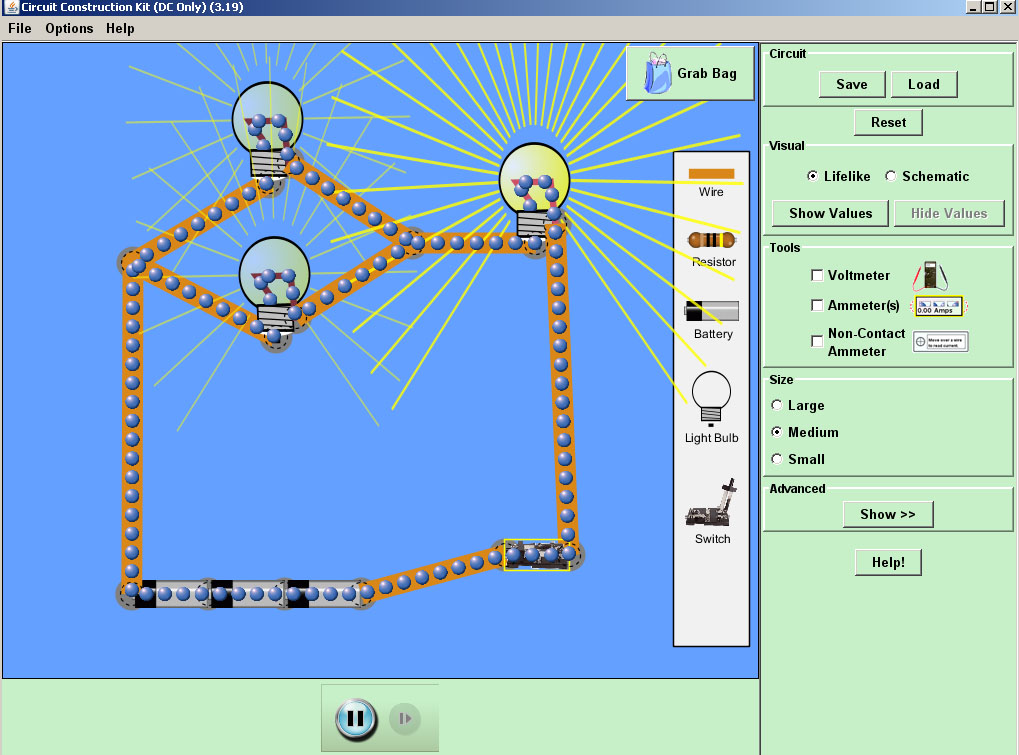
The light bulbs that are in parallel are in series with the other light bulb. The single light bulb is much brighter that the ones in series, which are the same brightness. The voltage of the series is equal to the voltage of the bulbs in parallel. The current of the complex circuit is the total voltage divided by the combination of both currents through the series and parallel circuits. The equivalent resistance is found by combining the resistance of the parallel light bulbs with the light bulb in series. As more light bulbs are added, the resistance could increase or decrease, depending on weather the light bulbs are in series or parallel.
Tuesday, May 17, 2011
Tuesday, May 10, 2011
Stupid Zombies Hall of Mirrors
Step right up ladies and gentlemen. Come and compete for your chance to win. Simple hit the zombie first and you are the victor. Just bounce your laser off the mirrors to hit your target. Based off of the acclaimed app, Stupid Zombies. Compete to put your name the leader board. Check it out!
https://sites.google.com/a/parishepiscopal.org/physics-honors/amusement-park/team-2
Team 2 wiki page
https://sites.google.com/a/parishepiscopal.org/physics-honors/amusement-park/team-2
Team 2 wiki page
Wednesday, April 27, 2011
In the Rays of the Sun
Natural photograph of the waves of visible light from the sun
The sun is the only provide of natural, visible light. This light travels at 3 X 10⁸ m/s, the speed of light. The visible light from the sun is the smallest section of the Electromagnetic Spectrum. These visible light waves are the middle in size and frequency of the Electromagnetic Spectrum. This light is what allows us to see all of our favorite colors. Isaac Newton invented the prism to visualize the colors. The different colors of the light are seen in different frequencies. The “cooler” colors have shorter wavelengths, while the warmer colors have longer wavelengths. The prism changes the “white light” into all these different frequencies. Water has the same ability as a prism, hence rainbows. The lens of my camera became a mini prism and mad little red circles, changing the frequency of the light. Parts of the sun’s rays are absorbed by the earth, and parts are reflected back into the sky. This photo is titled, In the Rays of the Sun, because the rays of the sun move our world. Quite simply, the main use of the sun’s rays is to be able to see things.
Tuesday, March 29, 2011
Through the Spectrum of Electromagnetics
Another story from my Physics life. Since we are now studying waves I must understand the different types of waves in the, ELECTROMAGNETIC SPECTRUM? What is that, well I didn't know until I did a little research.The EM spectrum is the space in which all of the waves that people use travel through. Like gamma rays, X-Rays, Ultraviolet rays, Infrared rays, Microwaves, and Radio waves, ordered from smallest to largest. We use all of these waves every day, from doctors using X-Rays, to regular people popping popcorn. All of these waves could take hours to explain, so I will focus on two; X-Rays and Radio Waves.

There you have it. That is my in depth look into the WWES (Wide World of the Electromagnetic Spectrum).
Attributions:
https://www.whitbypandemonium.co.uk/images/XRay-Cat-Patch.jpghttp://school.discoveryeducation.com/lessonplans/interact/electromagneticspectrum.html
http://collegehilloh.net/enewsletterarchive/images/graphics/radio%20interference.jpg
Monday, January 24, 2011
My Journey Through Energy Transfers
This is a presentation of how energy is transferred in nature. Birds use the transfer of Gravitational Potential Energy to move and survive. Birds transfer all of their Potential energy into Kinetic Energy so that they can fly at blazing speeds and catch prey.
http://english.pravda.ru/images/photo/3/0/0/35300.jpeg
http://www.hickerphoto.com/data/media/161/birds-of-prey_T5808.jpg
Create your own video slideshow at animoto.com.
The system in this particular example is the bird and the earth. The only transfer of energy is from full Potential to Kinetic and some potential. The bird dives down, reducing air friction in an aerodynamic shape. This transfers all of the Energy to Kinetic energy. The formula for the bird's energy would be PEG=KE. Velocity, in meters per second, and mass, in kilograms, are necessary for solving the Kinetic energy as 1/2xv^2, in Joules. The height, in meters, the mass, in kilograms, and the gravitational pull of the earth, 9.8 meters per second squared, are necessary for solving the Potential Gravitational Energy as mgh. That's my story of Energy Transfers and how it relates to the beauty of nature.
Attributions
http://www.hickerphoto.com/data/media/161/flying-birds_T5301.jpghttp://english.pravda.ru/images/photo/3/0/0/35300.jpeg
http://www.hickerphoto.com/data/media/161/birds-of-prey_T5808.jpg
Create your own video slideshow at animoto.com.
Wednesday, January 5, 2011
Mythbusters Lab 2
Myth #2: An object always changes its motion if there is a force exerted on it.
Statement: If an object always changes its motion if there is a force exerted on it by other objects, and we roll a ball at a bottle, then the ball will stop.
The sum of the forces is -Fn1 but the ball rolls through the bottle without changing direction, disproving the myth.
Conclusion:
My prediction was wrong since the ball rolled straight through the bottle and didn't change direction at all. I believed that the ball would somewhat change direction, but nothing of that nature happened. If the ball had hit a wall, then the ball would have bounced back and changed in the complete opposite direction. This is a commonly believed myth. When there is a large force at play, but when there is a small force it doesn't affect it at all. The myth is one of those "no duh" type things, but it turned out to be false.
Sunday, January 2, 2011
Mythbuster Lab 1
During this episode, I will be testing a myth sent to me by my physics teacher.
Myth: An object always moves in the direction of the net force exerted on it.
Prediction: If an object always moves in the direction of the net force exerted on it, and we drop a ball on the ground, then the ball will bounce, and continue in the opposite direction of the force of gravity, disproving the myth.
The sum of the forces is -Fg while the ball is in the air after it hit the ground, but it is still rising and it comes back to Tori.
Conclusion:
The myth is busted because the ball rose and came back to Tori. Originally, I thought that this would be very difficult to bust, but I believe that this test thoroughly busted the myth. Most people would believe this myth because an object mostly moves in the direction of the applied force, which is probably the origin of this myth. Our testing busted the myth, and I hope that this will make people rethink their thought process.
Tuesday, December 7, 2010
Newton's Laws, my journey
Sir Isaac Newton is most famous for discovering gravity and his three laws of motion. Most recently, my Physics class has been learning about Sir Isaac Newton's laws, and learning about how they work. Newton's First Law describes an object at rest tends to stay at rest, and object in motion tends to stay in motion, unless acted upon. Both of these scenarios describe equilibrium. Newton's second law is describes acceleration, or an object that is not in equilibrium. Acceleration is caused by the amount of force that is exerted on an object, and the more mass an object has, the force is needed to move it. Finally, Newton's third law states that every action has an equal and opposite reaction. For example, when a cat traps a mouse's tail on the floor, the floor exerts an equal and opposite force on the cats paw.
I have found that second law problems are the most difficult because they involve acceleration. First Law problems are easier because they are in equilibrium and they variables on the axis equal zero and Third Law problems are also simple, because there is little math involved and the answer is in the problem. Second Law problems are much more challenging because of the amount of work needed to complete them.
Throughout the course of the year, I have noticed that I learn things at a slower pace than my teacher teaches it. Mrs. Gende goes boom, boom, boom ready, next thing. I thought that I was just horrible at Physics until I got an A on my exam when I was getting low Bs on my test. I realized that I really need to motivate myself to get better grades in Physics if I am going to be successful in High School.
I have found that second law problems are the most difficult because they involve acceleration. First Law problems are easier because they are in equilibrium and they variables on the axis equal zero and Third Law problems are also simple, because there is little math involved and the answer is in the problem. Second Law problems are much more challenging because of the amount of work needed to complete them.
Throughout the course of the year, I have noticed that I learn things at a slower pace than my teacher teaches it. Mrs. Gende goes boom, boom, boom ready, next thing. I thought that I was just horrible at Physics until I got an A on my exam when I was getting low Bs on my test. I realized that I really need to motivate myself to get better grades in Physics if I am going to be successful in High School.
Wednesday, October 20, 2010
Vector Review
A new concept that we learned in Honor's Physics was vectors. I learned that vectors have magnitude and direction, and that vectors can be combined to find their resultant. I also learned that the process of solving a vector uses trigonometry, a skill we learned earlier. I found that adding the vectors correctly to solve for the resultant and the tangent was the most difficult part of solving vectors. I did well in solving for the resultants and components of the vectors, but I ran into trouble when there were multiple vectors. Vectors can be connected to everyday life by traveling 30 miles East, and then 40 North and knowing that you displaced yourself 50 miles.
Projectile motion is the newest concept that we have discussed in Physics. I learned that the horizontal velocity of an object in the air does not change throughout the course of its flight. I also learned that an object in the air has two different velocities. I found that solving for the distances and ranges of that projectile in flight gave me much difficulty. I had much success with these problems when it gave me more than the initial velocity and the angle, and I struggled when they did. Projectile motion is seen every day in an sports game that has to do with hitting, kicking, or throwing an object.
Monday, October 11, 2010
The Story of Acceleration
One of the most common aspect of our lives is acceleration. As velocity increases, there is acceleration. In my Pixton, two robbers have a problem because they are being chased and they cannot get caught. They accelerate away from the police and they become millionares.
Tuesday, August 31, 2010
How to be Successful in Physics
- I am going to come prepared with my two spirals, planner, pencils, and a ruler. I will also come to class with my homework fully completed before class, and with it prepared to turn in.
- I will go to the Wiki if I need any help, and I will also go to some of the many links when I need extra practice.
- I will check the website for any changes in the assignments. I will also stay up to date with all of my assignments and Labs, and I will turn them in on time. After anytime that I am late, I will go to my, amazing, teacher for the assignment from the day that I was absent.
- I will learn all of the terms and vocabulary so that I can use them properly in class. I will also use the Four Step Plan to solve all of my problems by; Recording my Data, Forming an Equation, Using Substitutions, and Checking to make sure that my process is correct.
- The main thing that will help is being extremely organized with my papers and graphs. I must want to learn more and ask questions so that I can answer every question easily, and that I will be the "go-to" person for Physic's help. When I need help, I will turn to my teacher, my fellow students, and the Wiki.
These are set guidelines for me, and my fellow students. Everyone must follow these rules if they want to be a success in Honors Physics.
Subscribe to:
Posts (Atom)


